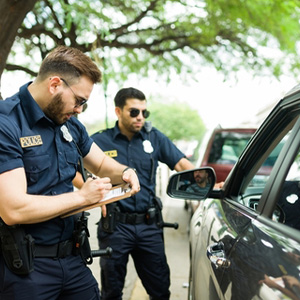
In this article, you can discover…
- How and when the police can search your vehicle in Texas.
- Whether you can legally refuse to allow the police to search your car.
- How to protect your legal rights and case during a vehicle search.
Under What Circumstances Can Texas Police Legally Search My Car?
All the police need to search your vehicle is a “probable cause” that a crime has taken place, is taking place, or is about to take place. What does that look like in real life?
If you forget to use your blinker to change lanes, that could warrant a stop. Alternatively, if the cop following you is convinced you’ve got dope in your car, they’ll follow you until you make a simple mistake, like forgetting to use your blinker. Is that legal? Absolutely, and this is known as a “pretextual stop”.
He stopped you under the pretext of a traffic violation, and now has the opportunity to come up to your car, sniff it for weed, or notice something else (anything else, really) that gives him “probable cause” to search your vehicle without a warrant.
“Probable cause” can be quite broad. The smell of weed, the smell of anything that smells like weed (such as legal hemp), and even nervousness on the part of a driver can all be used as “probable cause” to search your vehicle.
Do Texas Police Officers Need A Warrant To Search My Vehicle During A Traffic Stop?
No. “Probable cause” is an exception to the Fourth Amendment requirement for a warrant. And proving that the police did not have “probable cause” to search your vehicle can be more complicated than many people realize.
Your attorney will have to carefully look into the circumstances of your arrest to see if the officer had an adequate cause to interact with you. For example, if you’re parked in public at 2 am and your motor is running, is that adequate cause for an officer to knock on your window and conduct a DWI investigation? Perhaps, but perhaps not. And legally, reasonable suspicion of a crime is all it takes to initiate a “detention.”
During a detention, you are not under arrest, but you are not free to leave until the officer concludes their investigation. If you do try to leave, you’ll commit a new crime known as “evading arrest”. And to find yourself detained, an officer’s “reasonable suspicion” is all that’s needed.
Can An Officer’s “Probable Cause” To Search My Vehicle Be Questioned?
Sometimes. For example, an officer may believe that you committed a traffic violation by simply wobbling within your own lane. You didn’t cross a lane barrier, but your driving was slightly uneven. You therefore haven’t committed any crime, even if the officer who pulled you over mistakenly believed that you did.
An officer having no reasonable suspicion to pull you over can be a big mountain to climb as a defense strategy, but if it holds up, then nothing the officer noticed, smelled, or found in your vehicle as a result of the stop can be admitted as evidence against you. In some cases, when an officer genuinely gets it wrong, their “reasonable suspicion” to initiate the traffic stop can be questioned.

Attorney Matthew Maddox is a seasoned, determined criminal defense attorney serving Texas. Since 1996, he’s helped clients just like you understand their options and fight successfully for their legal rights after a traffic stop.
Have questions, or in need of legal help? Reach out to Maddox Law, PLLC for an initial consultation today.
Can I Legally Refuse A Vehicle Search During A Traffic Stop In Texas?
You can and should always refuse to give your verbal consent to a vehicle search. If the officer asks you, even if they ask very politely, “Can I search your vehicle?” or “Do you mind if I have a look around your car?”, never give your consent. Politely refuse.
If the officers proceed with the search anyway, never interfere. Interfering with or attempting to stop the search could land you with felony charges such as “obstruction” or “tampering with evidence”.
What Mistakes Do People Often Make When Stopped By Police That Hurt Their Defense Later?
Two major mistakes are consenting to searches and talking too much. Many people assume that the police can’t use anything you say against you until your Miranda warnings have been read. This is untrue. Miranda rights only apply if you’re already in custody and are being interrogated.
The reality is that most arrests are conducted without Miranda warnings being given because people talk too much and because people give their verbal consent to vehicle searches. And police with ample experience have an uncanny ability to put people at ease, get them talking, and get you to say something that could give them a reason to arrest you.
The best advice I can give anyone who’s been pulled over is to be pleasant, be accommodating, avoid sudden movements, and, above all, be quiet. You may politely ask if you are free to leave, and may say, “I do not consent to you searching my vehicle”. Apart from this, avoid answering any pointed police questions without your attorney present.
Still Have Questions? Ready To Get Started?
For more information on car searches without a warrant in Texas, an initial consultation is your next best step. Get the information and legal answers you are seeking by calling (972) 427-5473 today.
Attorney Matthew Maddox is a seasoned, determined criminal defense attorney serving Texas. Since 1996, he’s helped clients just like you understand their options and fight successfully for their legal rights after a traffic stop.
Have questions, or in need of legal help? Reach out to Maddox Law, PLLC for an initial consultation today.


